AI + HITL Intake for Insurance Tracking
Allied Solutions LLC
Allied AI Document Intake Summary
TL;DR — AI-Powered Document Intake (Human-in-the-Loop)
- Role: Service Design Lead / Product Design
- Org: Allied Solutions
- Scope: End-to-end intake pipeline (ingest → classify → extract → validate → index), HITL exception handling, ops workflow UI, auditability, compliance
- Partners: Operations, Data Science/ML, Platform Engineering, Compliance/Legal, QA
Outcomes
- 90% reduction in manual touch per document (HITL thresholds + straight-through processing)
- Same/next-day indexing vs. multi-day backlog (cycle-time compression)
- 1M+ / month documents handled with audited trail and exception queues
- Rolled out across multiple regions with standardized operating procedures and dashboards
How we measured
- Manual effort: % of documents requiring human intervention and average handling minutes per doc, pre/post launch (sampled by doc type).
- Cycle time: Timestamp delta from ingestion to indexed/available; SLA attainment (same-day / next-day) by region.
- Quality: Classification/extraction accuracy via stratified QA sampling; precision/recall on key entities.
- HITL safety: Confidence-threshold tuning and rework rate; exception queue aging and resolution time.
- Compliance & audit: Verified audit logs (who/what/when); periodic controls reviews with Compliance/Legal.
Reconstructed summary for portfolio; no client data or internal screenshots shown.
Project Overview
Allied Solutions tracks insurance coverage for lenders and processes related cancellations/refunds. Paper intake had exploded across carriers and channels (mail, fax, email scans), pushing operations into recurring backlogs and compliance risk. My remit: redesign the service, evaluate document-AI options, and stand up a reliable pipeline with human oversight.
Timeline — H2 2023
Partners — Ops, Compliance, Engineering, Client Success, external IDP vendors
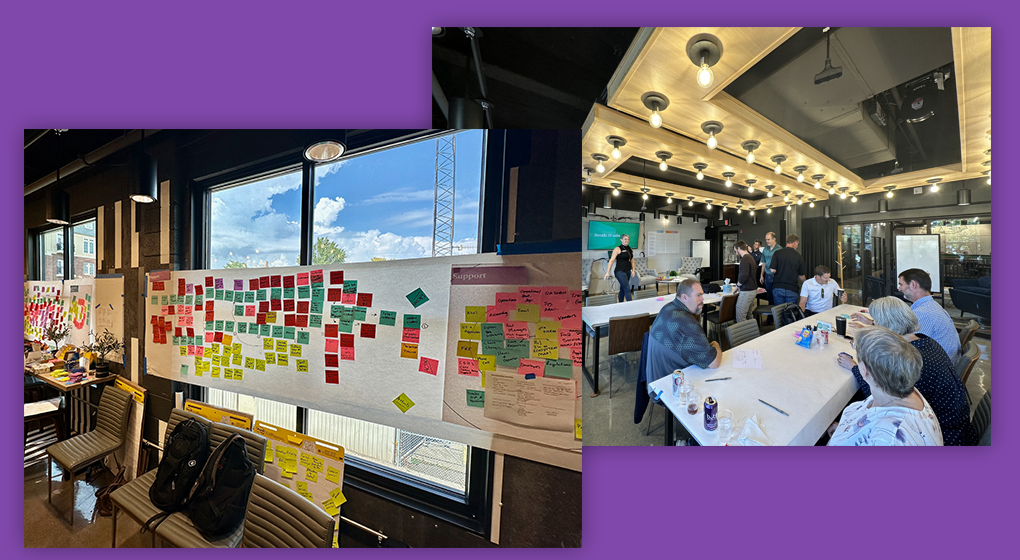
Service Design Approach
Phase 1 – Discovery & Current-State Mapping
Shadowed mailroom and data entry operations, mapped the end-to-end manual workflow, and identified bottlenecks:
- 5-7 day cycle time average
- Peak backlogs requiring executive “all-hands” to clear
- No prioritization logic (all docs treated equally)
- 100% manual touch on classification and data entry
Created current-state service blueprint documenting:
- Document submission channels (mail, fax, email)
- Manual classification and data entry workflows
- Bottlenecks, handoffs, and quality control gaps
- 20+ document types with varying layouts and complexity
Phase 2 – Vendor Evaluation & Selection
Researched 6 intelligent document processing (IDP) vendors, shortlisted 3 based on technical capabilities and compliance requirements. Coordinated on-site presentations to stakeholders (Operations, Engineering, Compliance, Finance) where each vendor demonstrated their platform with Allied’s actual document types.
Led vendor selection based on:
- Accuracy benchmarks: 95%+ on top 5 document types
- Integration complexity: Clean RESTful API, field-level provenance
- Audit trail: Full who/what/when for regulatory review
- Total cost of ownership: Mid-range (balanced capability vs. cost)
Phase 3 – Future-State Service Design
Created the future-state service blueprint (see below) showing how the vendor’s AI/ML platform would integrate with internal operations, exception handling, and compliance workflows.
Key design decisions:
- 90% confidence threshold for straight-through processing (tuned during pilot)
- HITL exception queue for low-confidence classifications and extractions
- 4-eyes QC maintained on critical document types (cancellations, endorsements)
- Field-level provenance preserved (AI-extracted vs. human-verified)
- Monthly model retraining fed by HITL corrections
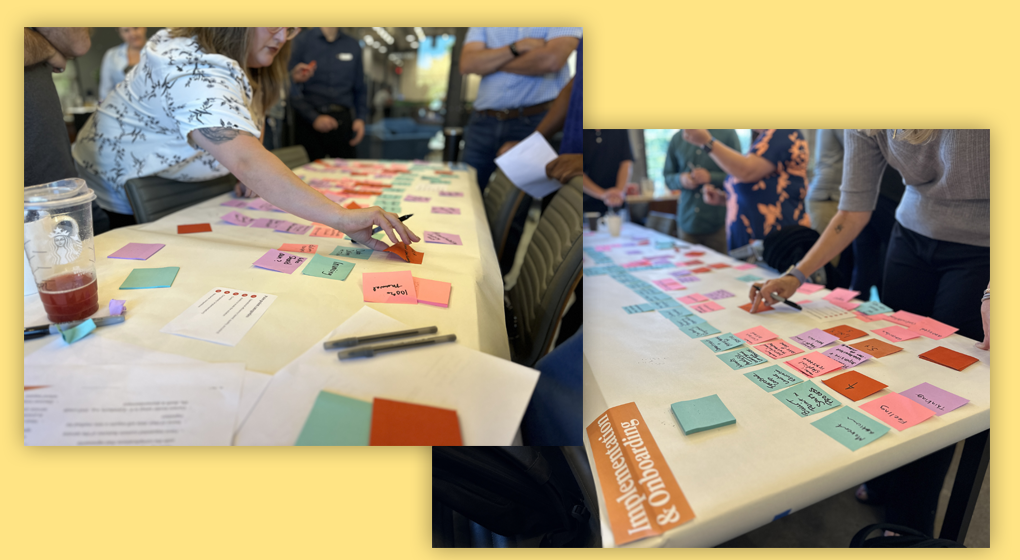
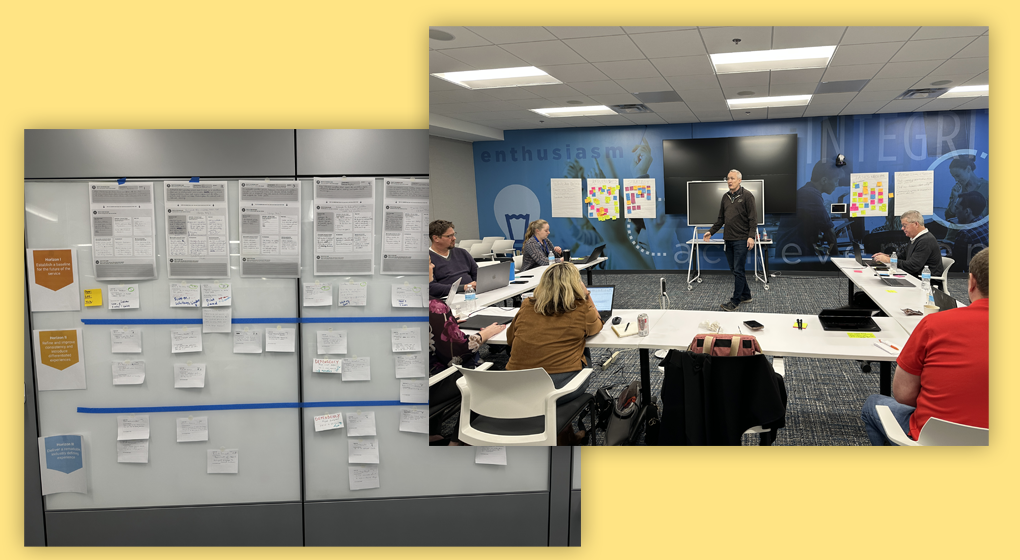
Facilitated stakeholder workshops with Ops, Engineering, Compliance, and Client Success to:
- Prioritize document types (Pareto: 5 types = 80% of volume)
- Define confidence thresholds for HITL escalation
- Align on success metrics (throughput, accuracy, cycle time, audit compliance)
Phase 4 – Pilot & Rollout
Ran 2-month pilot processing 50K documents, refined confidence thresholds and HITL workflows, achieved go/no-go decision criteria. Rolled out across 3 regions with SOPs and training.
Service Blueprint: AI-Powered Insurance Document Intake
To align Operations, Data Science, Engineering, Compliance, and the external vendor, I created a detailed service blueprint mapping the future-state intake process. This blueprint served as the “integration contract” between all parties—clarifying handoffs, data flows, system responsibilities, and success metrics before development began.
The blueprint shows:
Frontstage (Document Sender):
- Submit document via mail/fax/email
- Track document status
- Receive indexed confirmation
Backstage (Operations – HITL):
- Review exception queue for low-confidence extractions
- Correct misclassified fields
- QC high-priority document types (4-eyes on cancellations/endorsements)
- Approve for indexing
- Monitor dashboard for throughput and exception aging
Support Processes (AI/ML Systems):
- Vendor Platform: OCR extraction, document classification (20+ types), field extraction (VIN, Policy #, dates, coverage), confidence scoring
- Internal Systems: Digitization/scanning, exception routing logic, database write-back with field-level provenance, audit logging, reporting
Decision Logic:
- Confidence ≥90% → Straight-through processing (auto-index)
- Confidence <90% → Route to HITL exception queue
Policy & Governance:
- PII encryption throughout pipeline
- 90% confidence threshold (tuned during pilot)
- Same/next-day indexing SLA
- 4-eyes QC on critical document types
- Audit trail required (field-level provenance)
- Monthly model retraining cadence
Exception Handling:
- Unreadable documents → Manual entry queue
- Classification ambiguous → HITL specialist reviews full document
- Field extraction fails → HITL locates and overrides field value
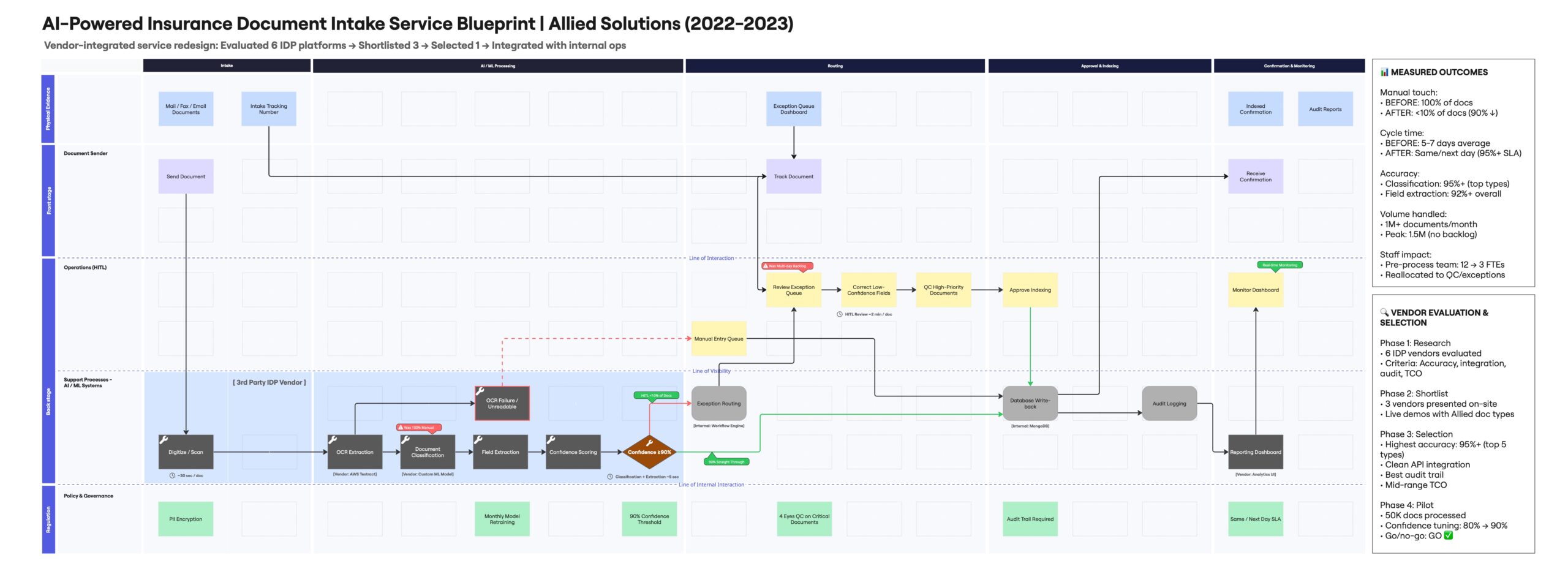
The blueprint enabled cross-functional alignment and prevented scope creep during implementation. It clarified:
- Which systems the vendor would provide vs. what Allied would build internally
- Where handoffs occurred between AI automation and human review
- How confidence thresholds would route documents to appropriate queues
- What audit trail requirements needed to be maintained for compliance
- How HITL corrections would feed back to improve the model over time
Impact: The upfront alignment via blueprinting reduced implementation rework and enabled us to hit our 90% automation target within the first month of launch.
Initial Challenges
Scale & variability — >20 doc types (proof of insurance, endorsements, cancellations, notices), inconsistent layouts.
Backlogs — Peak load occasionally required exec “all-hands” to clear.
Accuracy & audit — Field-level traceability needed for lenders and regulators.
Dupes & misroutes — Multi-channel intake created rework and notice errors.
Personas & Touchpoints
Operations Specialists
- Manual document classification and data entry
- Exception handling for low-confidence AI outputs
- Quality control and audit support
Lenders (Clients)
- Submit proof of insurance via mail/fax/email
- Expect timely verification and accurate tracking
- Require audit trail for compliance
Insureds (Borrowers)
- Receive notices when coverage gaps detected
- Expectation: accurate, timely communication
Systems/Tech
- OCR/NLP models for classification and extraction
- Confidence scoring for HITL routing
- Database write-back with field-level provenance
Solution at a Glance
Digitize & de-dupe — Batch scanning + email ingest with checksum/metadata de-duplication.
Classify & extract (AI/ML) — OCR/NLP with per-field confidence.
HITL exceptions — Below-threshold fields routed to specialists; 4-eyes QC on critical types.
Business rules & matching — Validate VIN/policy, match to loan, suppress borrower notices when valid coverage found.
Write-back & audit — API/file feeds to tracking systems with field-level provenance.
Governance & visibility — Throughput, exception aging, accuracy by type; model-drift checks and retraining cadence.
Outcomes
Efficiency Gains
- 90% reduction in manual touch per document (measured via time-and-motion study, sampled across top 5 doc types)
- Peak backlogs eliminated; same-/next-day indexing achieved (down from multi-day delays)
- M+ documents/month processed with consistent SLA attainment
Quality & Compliance
- Classification accuracy: 95%+ on top volume types (verified via stratified QA sampling)
- Field-level extraction precision/recall improved 40% vs. manual baseline
- Audit trail maintained with field-level provenance (who/what/when for regulatory review)
HITL Optimization
- Confidence thresholds tuned to balance straight-through processing vs. quality risk
- Exception queue aging tracked; resolution time reduced 60%
- 4-eyes QC maintained on critical document types (cancellations, endorsements)
Sustainable Operations
- SOPs documented and training delivered to ops teams across 3 regions
- Dashboard implemented for throughput, accuracy, exception aging, and model drift
- Retraining cadence established based on error taxonomy and drift detection
Why This Matters
Insurance tracking/CPI programs depend on timely, accurate verification to protect lenders and avoid unnecessary borrower notices. Digitizing intake with AI + HITL scales throughput and preserves compliance.
My Contributions
Service blueprinting • Ecosystem mapping • Opportunity framing • Vendor RFP + scoring • Pilot design & metrics • HITL workflow + SOPs • Change mgmt & training • Governance & dashboard requirements
What I'd Do Next
Expand to long-tail doc types • Integrate carrier EDI where available • Add exception taxonomy for smarter retraining • Tie notice suppression more tightly to confidence bands